Showing posts with label review. Show all posts
Sunday, March 29, 2015
Review: The Creation of Anne Boleyn
Who was Anne Boleyn? For centuries, the second wife of Henry VIII has been the subject of countless interpretations--fictional, biographical and everything in between. She has been cast in every possible role--as heroine and villain, as hapless victim of Henry's whims and political harbinger of her own tragic fate, as religious martyr and demonic temptress. Her story, retold countless times, continues to fascinate and inspire countless writers, artists, historians and readers.
The Creation of Anne Boleyn looks at the many metamorphoses of Anne Boleyn throughout history, which have manifested in historical works, literature and popular culture. In the first section of the book, author Susan Bordo revisits the real life of Anne Boleyn by discussing (and challenging) some of the commonly held beliefs about Anne; many of the beliefs that Bordo challenges come straight from the correspondence of one of Anne's most volatile enemies at court, the ambassador Chapuys. In challenging the facts about Anne Boleyn presented by Chapuys, Bordo also challenges many historians--modern and otherwise--who rely perhaps too heavily on Chapuys' correspondence for their interpretation of Anne Boleyn's life.
The second and third sections of the book tackles Anne Boleyn's many fictional representations after her death, including her portrayal in literature, theater and, more recently, film and television. Bordo looks primarily at Anne's portrayal in Anne of a Thousand Days, The Tudors, and The Other Boleyn Girl; brief mentions of other film and TV interpretations are also included.
In discussing how Anne has been revisited over the centuries in these fictional works, Bordo looks at broader social, political and entertainment trends that have influenced the way Anne has been depicted; despite the more recent historiography of Anne Boleyn challenging the notion of Anne as a shrewd vixen-like character, this type of Anne Boleyn, who seduces Henry VIII for her own gain and gets a 'comeuppance' in the end, has swung back around in the last decade or so with works such as The Other Boleyn Girl and in some respects, Hilary Mantel's Wolf Hall and Bring Up the Bodies novels.
The Creation of Anne Boleyn is an essential book for anyone with an interest in Anne Boleyn; it is also of interest to anyone who loves to study historiography and historical figures in popular culture.
Thursday, October 31, 2013
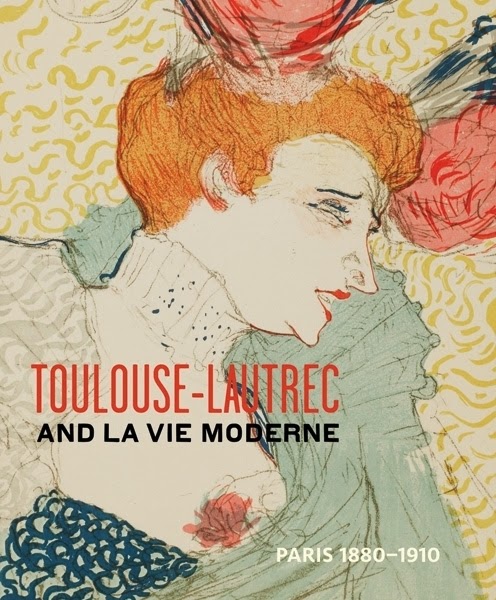
Review: Toulouse-Lautrec and La Vie Moderne, Paris 1880-1910
What did it mean to celebrate "la vie moderne" at the end of 19th century Paris? Toulouse-Lautrec and La Vie Moderne, which accompanies a traveling exhibition of the same name, seeks to explore the lives and works of numerous avant-garde artists who lived, worked and breathed the fin de siècle era.
The culture in Paris at the end of the 19th century seemed almost designed to host the vast artistic explorations, interpretations and experimentation that the city's many artists were producing at the time. Some of the most popular subjects during this 30 year period were of the city's artistic underside: its cabarets, circuses, even brothels; intimate scenes, such as domestic life or private moments, were also commonplace.
Toulouse-Lautrec and La Vie Moderne explores the artists, and their work, who re-imagined life in painting, sculpture and other ephemera in a fresh, modern way at the edge of the new century. The scope of the book is quite vast and includes substantial sections on Realism/Naturalism, Entertainment and Performance, Symbolism/Abstraction and Portraits. There are also some sub-categories in the larger sections, such as Daily Life, Landscapes and Toulouse-Lautrec. Each section features reproductions of artwork, with most of the images reproduced in larger sized and accompanied by biographical and analytical information. The information is written clearly and is accessible for general readers in addition to those with an interest or background in art history.
image: Lucie Cousturier at the Piano by Maximilien Luce
credit: my photograph
One of the paintings that immediately caught my eye while reading was Lucie Cousturier at the Piano by Maximilien Luce. This painting of an intimate daily scene, completed around 1905, is a striking portrait that speaks in color. The woman in the portrait was not just a random art model, but a woman known in the Neo-Impressionist circles of Paris. In addition to her work arranging art exhibitions, she produced her own artwork, mostly landscapes and still life paintings. She was also an accomplished art historian and published several studies on some of her prolific contemporary painters, such as Seurat, Signac and Henri-Edmond Cross.
Maximilien Luce, the artist, was a close friend of Lucie and painted her more than once. This particular portrait of her stands out because of its broad, impressive use of color. Everything from her clothing to the walls and even to the piano itself is showcased with impressions of color using wider brush strokes to give the impression of shadows, objects and even folds in fabric. The vibrant reds, blues, greens and whites play on each other to create a colorful, stylized image of a simple, daily scene: a young woman playing the piano.
Of course, the highlight of the book is the thirty-page (or so) section on Toulouse-Lautrec and his work. An entire review could be written solely on this well-illustrated section! One of my favorite 'Lautrec' pieces featured in the book is Le Divan Japonais, a poster created to celebrate the famous Divan Japonais cafe/cabaret. Divan Japonais came at a time when the Japonisme style, influenced by Japanese art and aesthetics, was heavily in vogue among European artists.
Toulouse-Lautrec's poster depicts Edouard Dujardin, a symbolist writer, accompanied by dancer Jane Avril; the pair are viewing a concert performed by Yvette Guilbert, well known for her signature full-length black gloves. Toulouse-Lautrec's use of color in this poster is similar to other Japonisme-inspired pieces produced around the same time, which often feature monochromatic color schemes accented with pops of brighter colors. Another poster featured in the Toulouse-Lautrec section of the book, 'Jane Avril,' features a similar "Japanese" inspired color scheme.
These are just two of the many pieces of art featured in Toulouse-Lautrec and La Vie Moderne. I highly recommended this lavish exhibition album for anyone with an interest in 'la vie moderne,' French art history, or simply "art" itself!
[A review copy of this book was given to me by the publisher in exchange for my opinion.]
Maximilien Luce, the artist, was a close friend of Lucie and painted her more than once. This particular portrait of her stands out because of its broad, impressive use of color. Everything from her clothing to the walls and even to the piano itself is showcased with impressions of color using wider brush strokes to give the impression of shadows, objects and even folds in fabric. The vibrant reds, blues, greens and whites play on each other to create a colorful, stylized image of a simple, daily scene: a young woman playing the piano.
image: Le Divan Japonais by Henri de Toulouse-Lautrec
credit: my photograph
Of course, the highlight of the book is the thirty-page (or so) section on Toulouse-Lautrec and his work. An entire review could be written solely on this well-illustrated section! One of my favorite 'Lautrec' pieces featured in the book is Le Divan Japonais, a poster created to celebrate the famous Divan Japonais cafe/cabaret. Divan Japonais came at a time when the Japonisme style, influenced by Japanese art and aesthetics, was heavily in vogue among European artists.
Toulouse-Lautrec's poster depicts Edouard Dujardin, a symbolist writer, accompanied by dancer Jane Avril; the pair are viewing a concert performed by Yvette Guilbert, well known for her signature full-length black gloves. Toulouse-Lautrec's use of color in this poster is similar to other Japonisme-inspired pieces produced around the same time, which often feature monochromatic color schemes accented with pops of brighter colors. Another poster featured in the Toulouse-Lautrec section of the book, 'Jane Avril,' features a similar "Japanese" inspired color scheme.
These are just two of the many pieces of art featured in Toulouse-Lautrec and La Vie Moderne. I highly recommended this lavish exhibition album for anyone with an interest in 'la vie moderne,' French art history, or simply "art" itself!
[A review copy of this book was given to me by the publisher in exchange for my opinion.]
Thursday, April 25, 2013
An Imperial Concubine's Tale: Scandal, Shipwreck, and Salvation in Seventeenth-Century Japan by G.G. Rowley
[A review copy of this book was provided to me by the publisher upon my request.]
Life in early 17th century Japan was a wild place, even for those privileged enough to live and work in the imperial palace. The wilderness of the court, however, was much vastly different than the wilderness of life outside the protected imperial walls. To live in the court was to live in service of the emperor and to pledge one’s self to live according to the rules of society. Both men and women needed to be careful never to overstep the boundaries of their station-if they did, they risked punishment which would range from the death penalty to banishment—the cruelty of the punishment usually rested on the good will and mercy of the emperor.
An Imperial Concubine: Scandal, Shipwreck and Salvation in Seventeenth-Century Japan by G.G. Rowley is a painstakingly researched look at the life and world of an often overlooked, and yet nonetheless remarkable woman living in 17th century Japan. Nakanoin Nakako was a noblewoman who entered into the imperial service when she was about 11 years old—the imperial Daily Records of January 19th, 1601 mark her entry simply: “The young lady, daughter of the Nakanoin, entered [the palace]; she was received in the anteroom with congratulatory cups of sake and strips of kelp.” The life she entered into was one centered on the life of the emperor; when she became of age, she would be fulfill duties such as serving the emperor his meals, presenting gifts to the emperor, bathing and clothing the emperor, and entertainment. Women of age, of course, would also attend to that duty inherent to the role of a concubine, although this duty is never recorded in the meticulous Daily Records.
Nakako’s life as an imperial concubine would soon be altered forever by what came to be known as the dragon-scandal. In the sixth month of 1609, a series of hurried entries in existing diaries of courtiers record the many rumors which were circulating about the “lax behavior” of imperial palace attendants. By the end of that same month, the imperial concubines were forbidden to leave their apartments due to an investigation. And by the beginning of the seventh month, the entries in the Daily Records turn ominous: “1st day: … His Majesty took his morning cup of sake. No meal was served because no one could be found.” It was not until the fourth day of the seventh month that the dragon-scandal finally broke. Five women, including Nakako, were restricted to the custody of their parents to await further instruction from the emperor. What, exactly, was the “lax behavior” they were accused of? Although the exact nature of the accusations varies from source to source, the women were essentially accused of leaving the imperial palace to attend parties in male courtier’s homes; attending then-taboo kabuki dances outside of the palace; and potentially having sexual relations with courtiers other than the emperor. At first, the emperor had a mind to execute all of the guilty parties in the scandal, including the women. However, he was eventually convinced to only execute the two men of lowest rank, while subjecting the rest of the men and women to exile.
Nakako herself would never make it as far as the official site of her banishment, the island of Nijima. Her boat shipwrecked in the harbor of Nagatsuro, which lies at the tip of the Izu Peninsula; a small village nearby would become her home for about 14 years. Not much is known about her life there, but contemporary accounts do record some instances of a peaceful life; Nakako directed the dancing of the villagers at harvest festivals, and even danced to entertain them herself. She became known as “Nakako-hime”—or princess Nakako.
In 1623, Nakako—and the other women implicated in the scandal—were pardoned and allowed to return to the capital once again. Although she was a young woman of 18 or 19 when she was exiled, she was now a mature woman in her early 30s. Unfortunately, Nakako herself drops off the record for more than a decade after her return to the capital. It is likely that she lived quietly at her family home with her mother, brother, sister-in-law and her family. In 1641, however, she reappears: eighteen years after her pardon from exile, Nakako joined an aristocratic convent. She eventually became an abbess and died in 1671, the longest-lived of her family in her generation, around the age of eighty.
Nakako did not leave behind extensive written records. Her story is primarily told through scraps of contemporary records, such as notes in the Daily Records, poetry, diaries, local records and even local legends. With some authors, this gap in historical records might result in an empty and sparse retelling of her life. Rowley, however, has the remarkable ability to flesh out the world of Nakako by using research on the lives of her contemporaries—such as the lives of imperial concubines in service of the emperor—in addition to documentation that still survives from contemporaries, including Nakako’s own father. While I’m sure readers will be left wishing that they could read something written by Nakako’s own hand, there is something almost enigmatic about the fact that all we have of her are these little traces, these little wisps, of who she once had been. A young woman, full of life, banished from the world she had known and torn from her family. This poem, composed by Nakako’s father after he received a letter from his daughter after her banishment, records his despair at their parting:
Could even the
Expected eternal parting
Compare with this?
I wonder at such a moment
Coming in my own lifetime.
Expected eternal parting
Compare with this?
I wonder at such a moment
Coming in my own lifetime.
I highly recommend An Imperial Concubine's Tale: Scandal, Shipwreck, and Salvation in Seventeenth-Century Japan by G.G. Rowley for readers interested in 17th century history, Japanese history, or women's history.
Friday, November 30, 2012
Review: We Are Witnesses: Five Diaries of Teenagers Who Died in the Holocaust by Jacob Boas
We Are Witnesses: Five Diaries of Teenagers who Died During the Holocaust by Jacob Boas reveals the diaries of five Jewish teenagers who, although they recorded their experiences during the war, were not able to survive the Holocaust that rapidly consumed those around them. The diaries of David Rubinowicz, Yitzhak Rudashevski, Moshe Flinker, Eve Heyman and finally, Anne Frank are each explored through a brief biography of the history and short lives of these teenagers along with a series of quotes from the diaries or other records that they left behind. Although Boas provides ample information about the lives of each diaries, none of the diaries are quoted extensively. We are told mainly of what the teenagers wrote about, and given long quote or two--but there is too much "tell" on behalf of the author when showing would have been a more effective way of revealing the characteristics of these teenager writers to the reader. Despite this shortcoming, the book is still a worthwhile introduction which may give readers both context and a starting point for reading the full diaries left behind by those who did not survive.
"Dear diary, I don't want to die. I want to live even if it means that I'll be the only person here allowed to stay. I would wait for the end of the war in some cellar, or on the roof, or in some secret cranny. I would even let the cross-eyed gendarme, the one who took our flour from us, kiss me, just as long as they didn't kill me, only that they should let me live.--The last entry in the diary of Eva Heyman, before she and her family were deported to Poland. She was murdered in the gas chambers upon her arrival to Auschwitz.
Thursday, October 25, 2012
Review: The Resurrection of the Romanovs by Greg King and Penny Wilson
Anna Anderson. To say her name--even today--summons thousands of dissenting opinions about what may be one of the most controversial royal mysteries in recent memory. Was she the Grand Duchess Anastasia, miraculously saved from a horrible fate at the hands of her family's executioners? Or was she a pretender, complicit in a hoax that captivated millions for the better part of the 20th century? All evidence points to one conclusion: Anna Anderson was not Anastasia. DNA testing in the 1990s on the discovered remains of the Romanov family and on multiple samples of Anderson's DNA concluded that she was not related to the Romanov family. Who, then, was she? Why did she claim to be Anastasia? And why would people, especially those who had some connection to the real grand duchess, believe her story? How did a lie which had no factual basis become an inescapable legend firmly rooted in the minds of the public?
In The Resurrection of the Romanovs: Anastasia, Anna Anderson and the World's Greatest Royal Mystery, Greg King and Penny Wilson tackle the answers to these questions about the woman who became known as Anna Anderson and her claim to be the Grand Duchess Anastasia with meticulous detail. King and Wilson begin by recounting the short life of the real Anastasia, who was born into a world of unimaginable privilege and ended her life in captivity with her parents, siblings, and a handful of loyal servants. In the aftermath of the Romanov execution, uncertainty was born. There was no official resolution to the fate of the family. Rumors of survival and execution traveled around the world, from mainstay newspaper publications to the gossip of former Russian courtiers in Berlin apartments.
It was in this atmosphere of uncertainty that a young woman, who had been hospitalized after a suicide attempt in Berlin, claimed that she was the Grand Duchess Anastasia. But her claim, which may have gone unnoticed as a mere wild statement by someone with a mental instability had circumstances gone otherwise, took on a life of its own--soon, she was living with courtiers, being discussed by newspapers around the world, being addressed as Her Imperial Highness, and living in European castles. She traveled around Europe, to America, to Germany, and back again. Her story was made into books, plays, and feature films during her lifetime. She was supported by some, reviled by others, and pitied by a few. This woman would be known by many names throughout her life: Fraulein 'Unknown,' Fraulein Annie, Frau Anastasia Tchaikovsky, Anna Anderson, and Anastasia Manahan. The name she was born with was, in the end, Franziska Schanzkowska.
Throughout their dissection of the story of 'Anna Anderson,' King and Wilson are quick to debunk many of the myths which made her story so enticing and so believable--not only to readers following the story in books and newspapers, but even to some who knew Anastasia or her family. Much of the information released to the public about Anderson and her claim was, at best, edited. Published evidence of Anderson's claim was often revised by one of her most prolific supporters, Harriet Ellen Siderowna von Rathlef-Keilmann, who removed details which might produce suspicion about Anderson and added details which supported her claim. Her book about Anderson was widely printed, while books which debunked the myth were left to go out of print, or left untranslated.
King and Wilson cover ample ground with Anderson's claim and her long life, which ended at the age of 87 in the 1980s. From there, they discuss the discovery of the remains of the Romanovs in 1990s and the decision to test Anderson's DNA against the remains of the Romanov family. And finally, the discovery that she was Franziska Schanzkowska is revealed in the final chapters, where her real life--and the reason why her identity was obscured--are finally revealed.
In many ways, The Resurrection of the Romanovs is not just the story of Anna Anderson's claim to be Anastasia. It is a resurrection of the real Anna Anderson, the real Franziska Schanzkowska, who had been lost to history through a hoax of her own making. I highly recommend this book to anyone interested in Romanov history or royal history--it is essential reading for anyone interested in Anastasia, for her story, for better or worse, would not have reached so many were it not for this imposter and her claim. I will end with this apt quote: "It is the greatest irony in Franziska’s tale: the farm girl from an obscure German village turned the real grand duchess, whose name appropriately meant “Resurrection,” into a modern legend."
Tuesday, August 7, 2012
Review: Treacherous Beauty: Peggy Shippen, the Woman behind Benedict Arnold's Plot to Betray America by Stephen H. Case and Mark Jacob
[A review copy of this book was provided by the publisher upon my request.]
When most people consider the role that women played in the American Revolution, they probably turn right to women like Abigail Adams or Molly Pitcher, who both supported the revolution in their own ways. But what about the women who did not support the revolution or who even worked against it?
Treacherous Beauty: Peggy Shippen, the Woman Behind Benedict Arnold's Plot to Betray America by Stephen H. Case and Mark Jacob is the first modern popular biography of this enigmatic and often ignored figure in American history--Peggy Shippen, the wife of the infamous Benedict Arnold. Peggy, born Margaret, was born into the world of Philadelphia's high society. Not much is known about her early childhood, although Case and Jacob suggest that she received an above-average education for her sex and learned much about finances through her father and mother. She came of age during the American Revolution in British-occupied Philadelphia and developed a strong social reputation. She was considered to be one of the most beautiful women in the city and frequently attended balls and other social gatherings with others of her rank--and British soldiers, including one John André, who would later play an important role in the "Benedict Arnold plot."
Peggy was considered to be beautiful, loving and sweet, but she was not Benedict Arnold's first choice for a new wife. Case and Jacob point out that many of the lines Benedict used in his courting letter to Peggy were, in fact, recycled from letters he had written to a previous potential wife. However, the two were eventually married and what soon followed is the subject of much debate and controversy, even today. How much of a role did Peggy Shippen play in Benedict Arnold's decision to become a spy for Britain? Did she know about his betrayal?
Although the title of the book labels Peggy to be the woman "behind" the plot, I don't think that the authors, if it was their attention to paint her as the mastermind, successfully provided enough evidence to suggest that Peggy was in fact behind the betrayal. Unfortunately, much of Peggy's correspondence was destroyed or burned in the wake of the plot, perhaps to save her reputation. In the past, Peggy's involvement in the plot to has been downplayed at best and completely ignored at worst--"the poor innocent wife of Benedict Arnold," as she was called after news of his betrayal broke out. And although they do not provide a strong case for Peggy being the woman "behind" the plot, Case and Jacob provide ample information which not only indicates she knew about Benedict Arnold's betrayal--but that she helped him as well.
The plot to betray America is, understandably, the real meat of the book. Because there are gaps in the recorded history of Peggy's life, some of the narrative focuses much more on the actions of Arnold--whom Peggy often followed--and John André, who left behind a more tangible historical trail than Peggy Shippen. However, Case and Jacob have made excellent use of the resources they had to create an interesting and rounded narrative of Peggy's life--from her birth in pre-revolutionary American to the betrayal of the revolution and to her last years in England, where she spent most of her time dealing with poor state of her family's finances and securing a future for her children.
I recommend Treacherous Beauty: Peggy Shippen, the Woman Behind Benedict Arnold's Plot to Betray America by Stephen H. Case and Mark Jacob to readers who are interested in the American Revolution, 18th century, or women's studies in the 18th century.
Friday, July 6, 2012
Via Tea at Trianon: Review: The Divorce of Henry VIII by Catherine Fletcher
Tea at Trianon:
The Divorce of Henry VIII (UK title: Our Man in Rome) by Professor Catherine Fletcher of Durham University is an indispensable addition to the library of any serious scholar of Tudor history. I say "serious" scholar because, while the book is not overlong, it is not light reading. It might be challenging for some to keep track of all the various players and intertwining events unless one is already deeply immersed in the politics of the King's Great Matter. However, after glancing at the author's extensive bibliography, I must commend her for being able to concentrate so much detailed research into one volume. It includes material rarely covered by other works about Henry VIII, shedding light on the fascinating world of sixteenth century ambassadors.
Read more.
Tuesday, June 26, 2012
Review: Every Step a Lotus: Shoes for Bound Feet by Dorothy Ko
(Note: I apologize for the unaccounted inactivity for the past month--real life has been taking up a lot of my energy and I was short on time to devote to this blog until now!)
The word "footbinding" conjures up two distinct images: the intricate and impossibly small "lotus shoes" and the women with deformed feet who wore--and, for a dwindling number of older Chinese women, still wear--them. While these two images are certainly part of footbinding, they are merely pieces of a much larger cultural puzzle that made up a practice which lasted for at least four centuries. Every Step a Lotus: Shoes for Bound Feet by Dorothy Ko fills in more of this puzzle by providing an overview of the history of footbinding, its development and adaptation through varying Chinese cultures, and how--and possibly why--footbinding played such a large role in the vital but often overlooked "inner circle" of women's society in Qing China.
It is clear from the outset of this book that Kohas chosen to approach footbinding from a historical and cultural viewpoint, rather than from one which casts judgement on the practice of footbinding from a modern viewpoint. "As a historian who has studied footbinding and women's cultures for years," she writes, "I do not claim to be neutral. I feel strongly that we should understand footbinding not as a senseless act of destruction but as a meaningful practice in the eyes of the women themselves." Although the pain and deformations caused by footbinding are discussed (and, in a few photographs, shown) Ko does not linger on them outside of providing an informative though, of course, shocking "instructional" illustrated guide to how footbinding was usually performed. However, most of the book explores the shoes worn after footbinding and the role that both the practice and lotus shoes had in the lives of women of varying social standing throughout several centuries of Chinese history.
Although footbinding was a consequence of living in a society which was ruled and dominated by men, the world and culture of footbinding was ruled and dominated by women. Footbinding, in essence, was strictly within the female domain. Female matchmakers and other respected women in a village or area would be consulted before the process of footbinding began in order to ensure that the process was started during the correct time. Mothers, aunts, and elder sisters would perform the act of footbinding on daughters and other young girls in the family. They would also teach those girls to create well-made and intricate lotus shoes, which were not only for practical purposes--the girls would need to be able to create footwear for their bound feet, in varying sizes as their feet became smaller--but also to help improve their chances of making a successful marriage match. Girls who could create well made shoes with fine and detailed designs were favorable to those whose work was more or less shoddy. Matchmakers would not only assess the size of a girl's feet, but her ability to create shoes and perform other essential female work. A young woman's ability to create fine lotus shoes would also make her transition into a new household after marriage much easier, as this skill was highly valued.
In addition to the vivid descriptions of how footbinding fit into female Chinese society, the book features numerous colorful photographs of lotus shoes from various Chinese cultures. Many of these shoes have never been on public display due to their delicacy and were seen by the public for the first time in this book. From a cultural standpoint, it is very interesting to see how the shoes varied depending on the region and time period. Lotus shoes from mountain regions, for example, tended to be bigger and more sloped to allow for women to more easily navigate the harsh terrain. Almost all of the shoes feature beautiful embroidery and vivid colors, which makes it easy to see why having the skill to make these shoes was so highly valued.
Every Step a Lotus: Shoes for Bound Feet by Dorothy Ko is an essential look at the practice of footbinding from a historian intent on placing this cultural practice back into its historical context--as an important piece of the puzzle of women's lives during Qing Dynasty China. I highly recommend this book for anyone interested in Chinese history, women's studies, or unique historical fashion.
The word "footbinding" conjures up two distinct images: the intricate and impossibly small "lotus shoes" and the women with deformed feet who wore--and, for a dwindling number of older Chinese women, still wear--them. While these two images are certainly part of footbinding, they are merely pieces of a much larger cultural puzzle that made up a practice which lasted for at least four centuries. Every Step a Lotus: Shoes for Bound Feet by Dorothy Ko fills in more of this puzzle by providing an overview of the history of footbinding, its development and adaptation through varying Chinese cultures, and how--and possibly why--footbinding played such a large role in the vital but often overlooked "inner circle" of women's society in Qing China.
It is clear from the outset of this book that Kohas chosen to approach footbinding from a historical and cultural viewpoint, rather than from one which casts judgement on the practice of footbinding from a modern viewpoint. "As a historian who has studied footbinding and women's cultures for years," she writes, "I do not claim to be neutral. I feel strongly that we should understand footbinding not as a senseless act of destruction but as a meaningful practice in the eyes of the women themselves." Although the pain and deformations caused by footbinding are discussed (and, in a few photographs, shown) Ko does not linger on them outside of providing an informative though, of course, shocking "instructional" illustrated guide to how footbinding was usually performed. However, most of the book explores the shoes worn after footbinding and the role that both the practice and lotus shoes had in the lives of women of varying social standing throughout several centuries of Chinese history.
Although footbinding was a consequence of living in a society which was ruled and dominated by men, the world and culture of footbinding was ruled and dominated by women. Footbinding, in essence, was strictly within the female domain. Female matchmakers and other respected women in a village or area would be consulted before the process of footbinding began in order to ensure that the process was started during the correct time. Mothers, aunts, and elder sisters would perform the act of footbinding on daughters and other young girls in the family. They would also teach those girls to create well-made and intricate lotus shoes, which were not only for practical purposes--the girls would need to be able to create footwear for their bound feet, in varying sizes as their feet became smaller--but also to help improve their chances of making a successful marriage match. Girls who could create well made shoes with fine and detailed designs were favorable to those whose work was more or less shoddy. Matchmakers would not only assess the size of a girl's feet, but her ability to create shoes and perform other essential female work. A young woman's ability to create fine lotus shoes would also make her transition into a new household after marriage much easier, as this skill was highly valued.
In addition to the vivid descriptions of how footbinding fit into female Chinese society, the book features numerous colorful photographs of lotus shoes from various Chinese cultures. Many of these shoes have never been on public display due to their delicacy and were seen by the public for the first time in this book. From a cultural standpoint, it is very interesting to see how the shoes varied depending on the region and time period. Lotus shoes from mountain regions, for example, tended to be bigger and more sloped to allow for women to more easily navigate the harsh terrain. Almost all of the shoes feature beautiful embroidery and vivid colors, which makes it easy to see why having the skill to make these shoes was so highly valued.
Every Step a Lotus: Shoes for Bound Feet by Dorothy Ko is an essential look at the practice of footbinding from a historian intent on placing this cultural practice back into its historical context--as an important piece of the puzzle of women's lives during Qing Dynasty China. I highly recommend this book for anyone interested in Chinese history, women's studies, or unique historical fashion.
Friday, April 13, 2012
Review: At the Edge of the Abyss: A Concentration Camp Diary, 1943-1944 by David Koker
[A review copy of this book was provided to me by the publisher upon my request.]
David Koker was only 23 years old when he died on route to Dachau in early 1945---just one of almost 6 million Jewish victims of the Holocaust. But his legacy, published in English for the first time as At The Edge of the Abyss: A Concentration Camp Diary, 1943-1944, has lived on. The diary, published by Northwestern University Press, is nothing less than a remarkable and essential read. David Koker was interned, along with his mother, father and younger brother, in the Vught camp in February 1943. He began his diary soon after, and maintained it until February of the next year, when the diary was given to a civilian employee working at Vught, who smuggled it out to a friend of Koker. The diary is not only a well-detailed account of life in the Vught camp, but a testament to Koker's internal struggles as he (and those around him) attempted to come to terms with the growing horror of their situation. Koker was a budding poet and intellectual, and some of the verses he drafted while interned in Vught are included in his diary. Also quoted in the book are several surviving letters and notes that Koker wrote and received while in the camp--letters and notes were often hidden in parcels, such as in loaves of bread.
In his introduction to At The Edge of the Abyss: A
Concentration Camp Diary, Robert Jan van Pelt explains why the diary's existence
is unique: "... the number of
postwar memoirs written by Holocaust survivors is enormous, and the number of
diaries and notebooks written during the Holocaust [by people who were] at
home, or in a ghetto, or in hiding is substantial, the number of testimonies
that were written in the inner circles of hell, in that German concentration
camp, and that survived the war is small." The ability to write a diary
under such circumstances would have been difficult enough, both emotionally and
logistically, but David Koker managed not only to write—but to write a
substantial and and highly observational diary, full of factual observations
about life in the camp and an increasingly psychological probe into the “abyss”
that surrounded them. Koker was able to obtain a relatively privileged position
in the camp, which was one of the reasons why he was able to maintain his diary
and maintain a sense of ‘detachment’ from camp life.
At first glance, David Koker's diary is remarkably subdued and
even subtle. Many of his diary entries describe unreal circumstances with an
almost nonchalant attitude. One reason for this apparent “normalcy” in his
diary could be that Koker felt assimilated and yet detached from camp life
early on. In March of 1943, less than a
month after having been imprisoned at the camp, he wrote to his girlfriend in
hiding: "I immediately accept everything as normal. That's why I don't
experience things sufficiently. ... You must believe me: from the second day on
everything was quite normal: the German detachments, being together with so
many people, the strange food, taking care of the most essential daily matters,
etc. I didn't notice the passage from one kind of life to the other ... even
the strangest and most awful things become normal and agreeable." Koker, at
least, was self-aware of how imprisonment had changed him: "You become
selfish, even towards your own family ... Sometimes I treat the children with
bitterness, yet the friendliest treatment hides a bit of sadism and lust for
power. ... A kind of feeling of being in charge."
In several passages throughout his diary, Koker mentions Poland and in particular, Auschwitz—the inevitable destination that we, in hindsight, know meant certain death. However, many of the people in Vught (and other camps) were not aware of the ultimate fate of people sent to Poland—or “to the East”—until much later. In September of 1943, Koker wrote: “… good reports are coming in from Poland. It’s only too bad that people really are working in the coal mines. But the work isn’t all that heavy, many writer.” A footnote goes on to explain that a special project was created in which Jewish inmates were, prior to being murdered, forced to write postcards to relatives, which were then sent out at intervals to give the impression not only of life but of relatively good conditions in the camps. In November, Koker wrote again: “ … the administrator has spoken about Auschwitz, where the [Escotex branch] will go in its entirety. Stories … have a more or less sunny aspect. Jewish camp leadership. A lot of agriculture, the camp is largely self-supporting. … If you ask me, it sounds livable.”
But the reality of “the East” came crashing down only a few weeks later, November 27th, on Koker’s birthday: “The morning of my birthday: Spitz reads an excerpt from a letter from Poland. Three people … are living with Moves [expression meaning “they are dead.”]. And Moves’s business is working overtime. … Seldom have I seen anything set out so clearly in writing … Our optimistic messages from Poland are not incorrect. They have simply been incomplete. A probably relatively small group is working and doing reasonably well. And the rest: wiped out. The world has changed.”
Koker’s diary is, at times, a difficult read. The diary is essentially a raw, first draft—unlike many of the writers who penned diaries in hiding or wrote postwar memoirs, Koker did not have the chance to edit his diary for his intended reader (his girlfriend) or a broader audience. However, numerous citations and footnotes provide ample information about almost all of the people and events mentioned in the diary. But perhaps the raw nature of Koker’s diary is part of what makes it such an important read, in addition to the irreplaceable information about daily life in the Vught camp. We are reading, at its heart, the inner thoughts of a human being—imperfect, as we all are—whose life was cut short by events he could not control.
I highly recommended At the Edge of the Abyss: A Concentration Camp Diary, 1943-1944 by David Koker, which was edited by Robert
Jan van Plet and translated from Dutch by Michiel Horn and John Irons. It is one of the most important contemporary accounts of a concentration camp currently published, and one of the most insightful and raw accounts of a human being put into an impossible situation that I've personally read.
Tuesday, March 27, 2012
Review: Gilded Lives, Fatal Voyage by Hugh Brewster
[A review copy of this book was provided to me by the publisher upon my request.]
It has been almost 100 years since the Titanic's ill-fated maiden voyage that took the lives of over 1,500 people. Since that fateful night, the story of the Titanic has been told again and again (and again) through books and film and even a successful Broadway musical. The question on many people's minds as the anniversary of the Titanic disaster looms is: Do we really need more books about Titanic?
Gilded Lives, Fatal Voyage: The Titanic's First-Class Passengers and Their World by Hugh Brewster answers this question with a resounding "yes." Although hundreds of studies have been published on the Titanic disaster, Hugh Brewster's newest book is not a rehashing of the same old "Titanic" story that we have heard time and time again. In many books, the story of the Titanic is the story of the ship itself: how big she was, how many people were aboard her, how she struck the iceberg and ultimately, how she sank. Gilded Lives, Fatal Voyage avoids making the Titanic center stage and instead thrusts the reader into the world of the most famous and noteworthy of Titanic's passengers. The story of the Titanic presented here is not a cold tally of the dead or a countdown of her lifeboats, but a human story about real people who lived and died and made human decisions that night, allowing the reader to "... place ourselves on that sloping deck and ask, 'What would we do?'"
It's clear from the outset that Brewster has done his research, not only on the Titanic (he has published previous works about the ship) but on the world of its first-class passengers and most remarkably, their personal lives. After all, it is one thing to read about the disaster and see an offhand remark about "Lucile Duff Gordan, a popular designer," or "Frank Millet, a popular artist and writer," who survived and did not survive the disaster, respectively. It is quite another to be presented a history of their lives--their loves, their losses, their passions and their personality--while eventually learning of their actions during the voyage and the impact that their life or death had on their world. Some readers may notice that Brewster sometimes has to rely on speculation, such as remarking that perhaps Lucille Duff Gordon wore a certain dress on a particular evening. Most of his speculations are based on research (in the previous example, Brewster is referring to a dress which was included in Lucille's cargo inventory) and, in my opinion, are simply a necessity of writing about what is ultimately a human story.
Brewster's writing is always engaging, always clear, and a pleasure to read. There are black and white photos related to the narrative included throughout the book, including some more uncommon photos of the passengers and first-class rooms. Included in the postscript of the book is a concise guide to the passengers mentioned in the book, with basic information about their lives, whether or not they survived the sinking, and (when applicable) their fate after the Titanic disaster.
I highly recommended Gilded Lives, Fatal Voyage to anyone who has an interest in the Titanic, whether they are picking up their very first books about the incident or have been studying the ship for years. It is definitely a worthy addition to the long list of Titanic studies, and I would say it's one of the most interesting and important newer Titanic books to come out in recent years. I would also recommend this to anyone with an interest in the end of the Edwardian age, especially early 20th century American politics, Edwardian fashion and social history.
Thursday, March 15, 2012
Review: Secrets of Versailles: The Palace and Beyond by Nicolas Jacquet
(This review was initially published on Reading Treasure.)
[I was provided a review copy of this book by the publisher upon request.]
"May readers understand that, behind the facades and the decors of the most beautiful palace in France, you can still sense the beating hearts of the men and women who once inhabited it and the history that unfolded there.
May they also understand that the palace is neither a dead site nor a placid memorial, but rather a living space which still aims to surprise and amaze visitors and fill them with wonder..."
So ends Jean-Jacques Aillagon's introduction to Secrets of Versailles: The Palace and Beyond by Nicolas Jacquet, a recent publication by Parigramme in partnership with the Chateau de Versailles. True to its title, the book is filled with secrets, surprises and tidbits about the history of Versailles and the people that once lived there.
There are about 200 or so entries in the book. The entries range from buildings to rooms to personal items and effects, such as the library of Madame du Barry, the last staircase ordered to be constructed by Louis XVI, and the "Treaty of Versailles" desk. Each entry also features one or more photographs of the place or item in question, a location for those who wish to visit and an asterisk (or double asterisk) to denote whether or not the entry is available for the public to see. Jacquet's writing is easily accessible in this English translations, and the photographs are well taken and printed nicely.
Some of the entries will be familiar to many, such as an entry for the Queen's village, while others are areas and items only available to those on private tours or not available to the public at all. My favorite entries were those offering those little secrets of life at Versailles, such as a view from the balcony at the Queen's House in the Petit Trianon, and the bathroom of the duchesse d'Angouleme during the Bourbon Restoration. Surprisingly, the book does not limit itself to the chateau of Versailles or its gardens, and extends its surprises to the city of Versailles, revealing many buildings and locations that are often ignored outright in many other books about Versailles. Those who might fear the book focuses solely on Louis XVI and Marie Antoinette need not worry, as the history discussed in the book ranges from Louis XIV all the way to the 20th century.
It's definitely a book I will keep in mind when I take my someday-soon trip to Versailles, and something I recommend for anyone interested in the history of the palace and the city, especially if you might be traveling there. I feel that knowing the history behind any location will make it all the more special. The human history behind locations can so often be lost when you're viewing them behind a computer screen or taking snapshots on a tour, but Secrets of Versailles really brings that history to the forefront, reminding us of the people and events that once passed through the city and palace of Versailles.
[I was provided a review copy of this book by the publisher upon request.]
"May readers understand that, behind the facades and the decors of the most beautiful palace in France, you can still sense the beating hearts of the men and women who once inhabited it and the history that unfolded there.
May they also understand that the palace is neither a dead site nor a placid memorial, but rather a living space which still aims to surprise and amaze visitors and fill them with wonder..."
So ends Jean-Jacques Aillagon's introduction to Secrets of Versailles: The Palace and Beyond by Nicolas Jacquet, a recent publication by Parigramme in partnership with the Chateau de Versailles. True to its title, the book is filled with secrets, surprises and tidbits about the history of Versailles and the people that once lived there.
There are about 200 or so entries in the book. The entries range from buildings to rooms to personal items and effects, such as the library of Madame du Barry, the last staircase ordered to be constructed by Louis XVI, and the "Treaty of Versailles" desk. Each entry also features one or more photographs of the place or item in question, a location for those who wish to visit and an asterisk (or double asterisk) to denote whether or not the entry is available for the public to see. Jacquet's writing is easily accessible in this English translations, and the photographs are well taken and printed nicely.
Some of the entries will be familiar to many, such as an entry for the Queen's village, while others are areas and items only available to those on private tours or not available to the public at all. My favorite entries were those offering those little secrets of life at Versailles, such as a view from the balcony at the Queen's House in the Petit Trianon, and the bathroom of the duchesse d'Angouleme during the Bourbon Restoration. Surprisingly, the book does not limit itself to the chateau of Versailles or its gardens, and extends its surprises to the city of Versailles, revealing many buildings and locations that are often ignored outright in many other books about Versailles. Those who might fear the book focuses solely on Louis XVI and Marie Antoinette need not worry, as the history discussed in the book ranges from Louis XIV all the way to the 20th century.
It's definitely a book I will keep in mind when I take my someday-soon trip to Versailles, and something I recommend for anyone interested in the history of the palace and the city, especially if you might be traveling there. I feel that knowing the history behind any location will make it all the more special. The human history behind locations can so often be lost when you're viewing them behind a computer screen or taking snapshots on a tour, but Secrets of Versailles really brings that history to the forefront, reminding us of the people and events that once passed through the city and palace of Versailles.
Thursday, March 8, 2012
Review: Blood Sisters: The French Revolution in Women's Memory by Marilyn Yalom
Blood Sisters: The French Revolution in Women's Memory by Marilyn Yalom is an exploration of the memoirs of women from a variety of social positions who, in some way, were affected by the French Revolution. These women range from female soldiers to the wives of prominent revolutionary figures to the only surviving child of Louis XVI and Marie Antoinette. The memoirs encompass a range of different experiences during the revolution as well as range of different "memories" of these events which are colored by the context the time period the memoirs were written in and the own personal ideals of the writer. In the book, Yalom not only explores the importance of historical context when reading these memoirs (a book written by a royalist during the Bourbon Restoration will naturally be colored by that context) but argues that the primary drive behind these memoirs - and indeed, many memoirs before and since the 18th and 19th centuries - is to bear witness to events which uprooted the country and resulted in the deaths of family, friends and countless others.
Blood Sisters excels in several ways. Yalom is clearly invested in this subject and her passion for these women and their writing shines in a narrative that is clear, engaging and incredibly hard to put down. The book also benefits because Yalom has chosen to engage the reader in these memoirs not only from a narrative point of view - explaining what happened to the women and what they wrote - but also from a critical point of view, exploring how these women wrote about what happened to them. Memory and personal conviction can have a great effect on what we write about our lives later in life, something Yalom doesn't hesitate to explore.
The one downside to this book is that I personally wish it was longer! As a side note, Yalom does provide an extensive list of memoirs written by women who were affected by the French Revolution, although this list only contains the French editions of these memoirs.
I highly recommend this book for anyone who is interested in women's memoirs, the study of women's history, or the French Revolution.
Friday, March 2, 2012
Quick Reviews: Fasting Girls, Hollywood Monster and Vive La Revolution.
Fasting Girls: The History of Anorexia Nervosa by Joan Jacobs Brumberg is an updated edition to Brumberg's critical study on the history of anorexia nervosa which was first published in the 1980s. Fasting Girls traces the history of the modern disease anorexia nervosa as well as the history of food refusal among young women, which dates back at least as far as the 16th century. Brumberg is careful to differentiate between these earlier historical cases of "fasting girls" and our more modern conception of anorexia nervosa. Brumberg argues that anorexia nervosa did not fully develop until the mid-late 19th century when increased social stability and heavy emphasis on mealtime as a sign of status in the growing upper middle class allowed for the development of a mental disorder which revolved around the consumption and control of food and weight.
Brumberg's writing tends toward the academic, but most readers shouldn't have trouble following her linear narrative which begins in the 16th century and continues until the 1980s, with a brief addition that was written at the start of the new millennium. Fasting Girls: The History of Anorexia Nervosa will appeal to anyone interested in the history of this mental disorder as well as the history of "fasting girls" in the 16th through the 19th centuries. The book will also be of interest to students or professionals in the mental health and wellness field.
Hollywood Monster: A Walk Down Elm Street With the Man of Your Dreams by Robert Englund recounts the now famous horror actor's early years in the theater and in Hollywood before landing his most iconic role: that of Freddy Kreuger in the first A Nightmare on Elm Street film and subsequent franchise. Although the memoir seems marketed as a book which focuses on Englund's "career" as Freddy Kreuger, it's actually more of a general overview of Englund's career and personal life. Englund's career before the first Nightmare film, which may be surprising to fans who only know him from the Nightmare franchise, includes classical theater roles, bit parts in plenty of older Hollywood flicks and small roles alongside growing major stars like Sally Field and Henry Fonda. Englund, of course, recounts his time filming A Nightmare On Elm Street and its many sequels as well as his other work during and post-Nightmare, such as his acclaimed role in the mini-series V.
The memoir is very casual but still engaging. The major flaw with this memoir is that Englund does not focus on any particular topic for very long. He briefly mentions roles or events or people but rarely goes into any great detail about any of them. Fans of Englund's portrayal of Freddy Kreuger will enjoy some anecdotes about the behind the scenes hijinks, but may be disappointed that there isn't really much dirt, gossip or secrets revealed in the course of the narrative. I would recommend Hollywood Monster for hardcore fans of the Nightmare franchise or readers who enjoy a casual, if sometimes flighty, Hollywood memoir.
Vive La Revolution: A Stand-Up History of the French Revolution by Mark Steel is a casual history of the French Revolution told in a conversational and comedic tone. Vive La Revolution covers the basics of the French Revolution, including its origins, major events and players and the subsequent consequences and results of the revolution. Steel's presentation of the revolution is noticeably sympathetic towards the revolution and most of its supporting figures. Some readers may find this refreshing, considering the glut of books in recent years which are more sympathetic toward the French royal family. However, Steel's argument that negative portrayals of "pro" revolutionary figures are mostly based in biased myth and legend is sometimes lost when Steel relies on legends or myths in his descriptions of aristocratic or royal figures. I would have preferred for the author to point out the inaccuracies of popular conceptions of all figures of the revolution, not just the ones he personally supported. The book also occasionally suffers from a lack of basic fact checking, such as mixing up the sister of Louis XVI with the sister of Marie Antoinette and then later, the niece of Louis XVI.
Despite these flaws, the book does manage to cover the revolution in a way that is engaging, especially for casual readers. I would mainly recommend Vive La Revolution to readers looking for something easy to read about the French Revolution, despite its occasional flaws, or readers who are fans of Mark Steel's comedic writing.
Brumberg's writing tends toward the academic, but most readers shouldn't have trouble following her linear narrative which begins in the 16th century and continues until the 1980s, with a brief addition that was written at the start of the new millennium. Fasting Girls: The History of Anorexia Nervosa will appeal to anyone interested in the history of this mental disorder as well as the history of "fasting girls" in the 16th through the 19th centuries. The book will also be of interest to students or professionals in the mental health and wellness field.
Hollywood Monster: A Walk Down Elm Street With the Man of Your Dreams by Robert Englund recounts the now famous horror actor's early years in the theater and in Hollywood before landing his most iconic role: that of Freddy Kreuger in the first A Nightmare on Elm Street film and subsequent franchise. Although the memoir seems marketed as a book which focuses on Englund's "career" as Freddy Kreuger, it's actually more of a general overview of Englund's career and personal life. Englund's career before the first Nightmare film, which may be surprising to fans who only know him from the Nightmare franchise, includes classical theater roles, bit parts in plenty of older Hollywood flicks and small roles alongside growing major stars like Sally Field and Henry Fonda. Englund, of course, recounts his time filming A Nightmare On Elm Street and its many sequels as well as his other work during and post-Nightmare, such as his acclaimed role in the mini-series V.
The memoir is very casual but still engaging. The major flaw with this memoir is that Englund does not focus on any particular topic for very long. He briefly mentions roles or events or people but rarely goes into any great detail about any of them. Fans of Englund's portrayal of Freddy Kreuger will enjoy some anecdotes about the behind the scenes hijinks, but may be disappointed that there isn't really much dirt, gossip or secrets revealed in the course of the narrative. I would recommend Hollywood Monster for hardcore fans of the Nightmare franchise or readers who enjoy a casual, if sometimes flighty, Hollywood memoir.
Vive La Revolution: A Stand-Up History of the French Revolution by Mark Steel is a casual history of the French Revolution told in a conversational and comedic tone. Vive La Revolution covers the basics of the French Revolution, including its origins, major events and players and the subsequent consequences and results of the revolution. Steel's presentation of the revolution is noticeably sympathetic towards the revolution and most of its supporting figures. Some readers may find this refreshing, considering the glut of books in recent years which are more sympathetic toward the French royal family. However, Steel's argument that negative portrayals of "pro" revolutionary figures are mostly based in biased myth and legend is sometimes lost when Steel relies on legends or myths in his descriptions of aristocratic or royal figures. I would have preferred for the author to point out the inaccuracies of popular conceptions of all figures of the revolution, not just the ones he personally supported. The book also occasionally suffers from a lack of basic fact checking, such as mixing up the sister of Louis XVI with the sister of Marie Antoinette and then later, the niece of Louis XVI.
Despite these flaws, the book does manage to cover the revolution in a way that is engaging, especially for casual readers. I would mainly recommend Vive La Revolution to readers looking for something easy to read about the French Revolution, despite its occasional flaws, or readers who are fans of Mark Steel's comedic writing.
Sunday, February 26, 2012
Review: Last Letters: Prisons and Prisoners of the French Revolution by Olivier Blanc
Last Letters: Prisons and Prisoners of the French Revolution by Olivier Blanc is an exploration of prisons and prisoners of the French Revolution through first-hand accounts, memoirs and--as the title would suggest--last letters written by condemned prisoners. The first section of the book details the conditions of the numerous prisons in revolutionary France, which ranged from horrendous to relatively livable, especially for wealthy prisoners during the earlier years of the revolution. Many prisons were in fact refubished chateaus, which were seized from emigrees, prisoners or those who had already been executed. These prisons often afforded prisoners more freedom and luxuries than the than the prisons being used in Paris, which were overcrowded, damp and increasingly restrictive as the revolution went on. This first half includes many excerpts from contemporary resources, usually the prisoners themselves, detailing their daily lives, escape attempts, and the general atmosphere of the prisons which grew increasingly restrictive and dangerous as the revolution bore on.
The second half of the book is, in my opinion, where the real "meat" of the book comes in. The second half is entirely "last letters," or the last letters written by condemned prisoners before they were executed.The letters were written to husbands, wives, children, mothers, fathers, neighbors, and even sometimes government officials. Common themes include forgiveness, debts, innocence and love--a testament to human nature. Almost all of the letters included in this volume were intercepted before delivery and never given to their intended receipiants, adding an entirely different layer to the already somber nature of these letters. Blanc typically provides an adequate background for each letter, detailing the person's lives, their crime or supposed crime, and occasionally reports of their behavior on the scaffold from contemporary newspapers.
I highly recommend this book for anyone interested in the French Revolution or the study of prisons and prisoners. It is also a moving read for anyone interested in social and personal history.
I've written out one of the shorter letters in the book. It was written by Gabriel Rochon de Wormesele, who was condemend to death for supporting the General Council of the Department of the Gironde, who in June of 1793 declared that the Natioanl Convention in Paris was corrupt and needed to be removed. The General Council also declared that they would form their own People's Commission for Public Safety that would not dissolve until the “liberty is re-established at the heart of the National Convention.”
The second half of the book is, in my opinion, where the real "meat" of the book comes in. The second half is entirely "last letters," or the last letters written by condemned prisoners before they were executed.The letters were written to husbands, wives, children, mothers, fathers, neighbors, and even sometimes government officials. Common themes include forgiveness, debts, innocence and love--a testament to human nature. Almost all of the letters included in this volume were intercepted before delivery and never given to their intended receipiants, adding an entirely different layer to the already somber nature of these letters. Blanc typically provides an adequate background for each letter, detailing the person's lives, their crime or supposed crime, and occasionally reports of their behavior on the scaffold from contemporary newspapers.
I highly recommend this book for anyone interested in the French Revolution or the study of prisons and prisoners. It is also a moving read for anyone interested in social and personal history.
I've written out one of the shorter letters in the book. It was written by Gabriel Rochon de Wormesele, who was condemend to death for supporting the General Council of the Department of the Gironde, who in June of 1793 declared that the Natioanl Convention in Paris was corrupt and needed to be removed. The General Council also declared that they would form their own People's Commission for Public Safety that would not dissolve until the “liberty is re-established at the heart of the National Convention.”
---
to Citizeness Wormeselle, rue du Temple, no 1
12 Brumaire.
These are the last letters that my hand will trace. In a few hours I shall be no more. I am condemned to death. My wife, whom I have always lovingly cherished, I die full of love for you. I do not ask you to remember me; I know your fine soul, your loving heart, no, you will never forget me. But go on living for our poor children. Remember me to them. May I serve as an example to them, may they be better than I. Raise them in the practice of the virtues. My property has been confiscated; there was so little that it will be no great loss to them. Raise them in the love of work. Lavish upon them all the love that you had for me. Farewell, a thousand times farewell. Wipe away your tears and concern yourself only with our children.
Wormeselle.
12 Brumaire.
These are the last letters that my hand will trace. In a few hours I shall be no more. I am condemned to death. My wife, whom I have always lovingly cherished, I die full of love for you. I do not ask you to remember me; I know your fine soul, your loving heart, no, you will never forget me. But go on living for our poor children. Remember me to them. May I serve as an example to them, may they be better than I. Raise them in the practice of the virtues. My property has been confiscated; there was so little that it will be no great loss to them. Raise them in the love of work. Lavish upon them all the love that you had for me. Farewell, a thousand times farewell. Wipe away your tears and concern yourself only with our children.
Wormeselle.
Friday, February 17, 2012
Review: Dairy Queens: The Politics of Pastoral Architecture by Meredith Martin
(Originally published at Reading Treasure.)
[I was provided a review copy of this book upon my request by Harvard University Press.]
Meredith Martin delves into more than two centuries of French history in her book Dairy Queens: The Politics of Pastoral Architecture from Catherine de Medici to Marie Antoinette, which seeks to place the French pleasure dairy back in its historical context, shattering the myths and assumptions about the role of pleasure dairies in elite society.
The assumption that pleasure dairies were built by royal women as a way to pretend at being peasants while not actually living like one has permeated books, films and pop culture for years. Marie Antoinette is still accused of pretending to be a peasant while drinking dairy from porcelain cups and milking perfumed cows -- a true example of a "Let them eat cake" (which no, she never said) state of mind. However, Martin puts the pleasure dairy of Marie Antoinette (along with several other prominent French women such as Madame de Pompadour and Catherine de Medici) in their historical context, dismissing the notion that the dairies were there for the frivolous play of the elite class.
Martin explores the political, social and gender politics behind the pleasure dairies, revealing a surprising role in the lives of the women or men who built and enjoyed them. Pleasure dairies were often ways for aristocratic or royal women to exercise a form of political power, while still working within their gender role by promoting their status as nurturing mothers and worthy estate managers. They were also a way to improve health, employing Rosseau's notion that aristocratic women should retreat to countryside estates and reap the benefits of fresh milk and air. The catch, of course, is that most pleasure dairies were not built in the true countryside but on the outskirts or even within cities, so that a woman could enjoy the benefits of the countryside without giving up her social obligations. However, the female influence on the pleasure dairy was, particularly by the 1780s, often criticized and made suspect. When the dairy at Rambouillet was built in 1787 (without input from Marie Antoinette) it was a noticeably different from her own dairy at the Trianon. Martin believes this was an intentional move by the male designer to, in a way, put Marie Antoinette back in her place. Marie Antoinette may have been the "goddess" at her Trianon, but not so at the 'male' dairy at Rambouillet.
In addition to discussing the historical role of the pleasure dairy from the 17th century through the French Revolution, Martin touches on the impact the pleasure dairy - and its political and gender ramifications - have had on modern society.
Martin's writing is clear, intelligently written and supplemented by many photographs, drawings and paintings. It's worth a mention here that the layout of this book is absolutely wonderful. I'll admit I was expecting a "dry" layout from a University press, but when I opened the book I was pleasantly surprised at the amount of images used. It's really a superb layout, and something that not only compliments Martin's writing but makes the book something worth looking through even after you've finished reading.
Overall, I definitely recommended this book to anyone interested in French history, especially Marie Antoinette and her much maligned pleasure dairy. It's an excellent addition to any library and I think most readers will find the insights about the often ignored pleasure diary interesting. The book was released earlier this year and is available at most online bookstores
[I was provided a review copy of this book upon my request by Harvard University Press.]
Meredith Martin delves into more than two centuries of French history in her book Dairy Queens: The Politics of Pastoral Architecture from Catherine de Medici to Marie Antoinette, which seeks to place the French pleasure dairy back in its historical context, shattering the myths and assumptions about the role of pleasure dairies in elite society.
The assumption that pleasure dairies were built by royal women as a way to pretend at being peasants while not actually living like one has permeated books, films and pop culture for years. Marie Antoinette is still accused of pretending to be a peasant while drinking dairy from porcelain cups and milking perfumed cows -- a true example of a "Let them eat cake" (which no, she never said) state of mind. However, Martin puts the pleasure dairy of Marie Antoinette (along with several other prominent French women such as Madame de Pompadour and Catherine de Medici) in their historical context, dismissing the notion that the dairies were there for the frivolous play of the elite class.
Martin explores the political, social and gender politics behind the pleasure dairies, revealing a surprising role in the lives of the women or men who built and enjoyed them. Pleasure dairies were often ways for aristocratic or royal women to exercise a form of political power, while still working within their gender role by promoting their status as nurturing mothers and worthy estate managers. They were also a way to improve health, employing Rosseau's notion that aristocratic women should retreat to countryside estates and reap the benefits of fresh milk and air. The catch, of course, is that most pleasure dairies were not built in the true countryside but on the outskirts or even within cities, so that a woman could enjoy the benefits of the countryside without giving up her social obligations. However, the female influence on the pleasure dairy was, particularly by the 1780s, often criticized and made suspect. When the dairy at Rambouillet was built in 1787 (without input from Marie Antoinette) it was a noticeably different from her own dairy at the Trianon. Martin believes this was an intentional move by the male designer to, in a way, put Marie Antoinette back in her place. Marie Antoinette may have been the "goddess" at her Trianon, but not so at the 'male' dairy at Rambouillet.
In addition to discussing the historical role of the pleasure dairy from the 17th century through the French Revolution, Martin touches on the impact the pleasure dairy - and its political and gender ramifications - have had on modern society.
Martin's writing is clear, intelligently written and supplemented by many photographs, drawings and paintings. It's worth a mention here that the layout of this book is absolutely wonderful. I'll admit I was expecting a "dry" layout from a University press, but when I opened the book I was pleasantly surprised at the amount of images used. It's really a superb layout, and something that not only compliments Martin's writing but makes the book something worth looking through even after you've finished reading.
Overall, I definitely recommended this book to anyone interested in French history, especially Marie Antoinette and her much maligned pleasure dairy. It's an excellent addition to any library and I think most readers will find the insights about the often ignored pleasure diary interesting. The book was released earlier this year and is available at most online bookstores
Saturday, February 11, 2012
Review: The Expert Cook in Enlightenment France by Sean Takets
[I was given a review copy of this book by the publisher upon my request.]
The Expert Cook in Enlightenment France by Sean Takats fills a much needed gap in 18th century studies by exploring the history of cooks in 18th century France. There has been much written about French food and cooking methods during this period, but precious little has been published about the people behind the food. Takats places the French cook back into the spotlight, providing a concise and informative overview on cooks, their work, their precarious role in society and how they hoped to strengthen that role through cooking during the Enlightenment.
Cooks, as Takats explains, held a unique place in 18th century society. Both men and women worked as cooks, and unlike other occupations which were primarily male or female, cooking was seen as neither masculine or feminine. The occupation of a cook was not entirely domestic, like a house servant, or entirely professional, like an architect. This in-between occupation created a greater degree of autonomy and freedom for cooks when it came to looking for employment. They often bargained with employers for wages and other benefits, and had much more freedom when working in the home than a typical domestic house servant. Cooks also published cookbooks, recipes and other instruction manuals, which was not common outside of 'behavior' manuals written with domestic servants in mind.
However, their role in society was at times contradictory. Although employers gave cooks much freer 'reign' than a typical house servant, cooks were greatly mistrusted. Satirical prints and stories about dirty, evil, and sexually promiscuous cooks abounded in 18th century France. Cooks intended to improve their status by reforming methods of cooking, recipes, and the kitchen itself, however these reforms only inspired greater suspicion of cooks and cooking. When 'modern cuisine' was developed, it was intended to showcase the power that cooking and food could have on the body and establish cooking as a legitimate science. These attempts to establish the importance of cooking only caused greater problems - after all, reason followed that if food could be used to improve health, it could cause destruction and death as well. The poor reputation of cooks at the time only helped to strengthen the stereotype of the cook as a dangerous, secretive person. Unfortunately, efforts by cooks to improve their reputation in society generally fueled the suspicion and derision he general populace held for them. However, despite this setback, cooks played an important role with 18th century society and used the Enlightenment to help pave the way for French cooking as we know it today.
It is a slimmer book - about 145 pages of text - but it provides a good overview of the role of cooks during this period and Takats' writing is academic but accessible enough for the general reader to enjoy. It was a surprising read for me, as I hadn't thought about cooks during this time period as anything other than a typical servant. It was enlightening to read about their unique position, and the surprising poor reputation that cooks had in society. I definitely recommend it for 18th century libraries, French studies libraries, and anyone particularly interested in the role of cooks during the 18th century.
Subscribe to:
Posts (Atom)
Search This Blog
About Inviting History
Inviting History is a book and history blog dedicated to especially interesting, overlooked or niche areas of history, as well as their interpretation in both non-fiction and literature.
Inviting History Book Reviews
Updated Tuesdays, Thursdays and Sundays with book reviews, historical posts, and more!
**Inviting History Has Relaunched as of April 2019!**
Inviting History Book Reviews
About Me
- Anna Gibson
- (Formerly Anna Amber)
"History is scholarship. It is also art, and it is literature."
I am a history loving writer who enjoys reading and blogging in my spare time. I currently run three blogs: Reading Treasure, a blog dedicated to books and more about Marie Antoinette and 18th century France; Treasure for Your Pleasure, a Tumblr microblog dedicated to Marie Antoinette and her world; and my newest blog, Inviting History, a book blog dedicated to unique and overlooked history books.