Showing posts with label france. Show all posts

Thursday, October 31, 2013

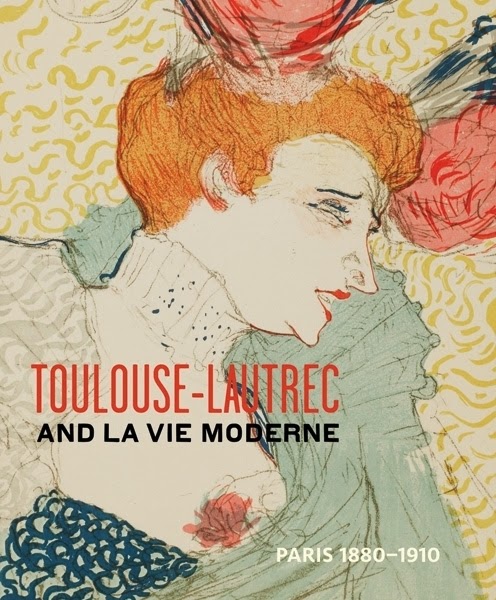
Review: Toulouse-Lautrec and La Vie Moderne, Paris 1880-1910


What did it mean to celebrate "la vie moderne" at the end of 19th century Paris? Toulouse-Lautrec and La Vie Moderne, which accompanies a traveling exhibition of the same name, seeks to explore the lives and works of numerous avant-garde artists who lived, worked and breathed the fin de siècle era.

The culture in Paris at the end of the 19th century seemed almost designed to host the vast artistic explorations, interpretations and experimentation that the city's many artists were producing at the time. Some of the most popular subjects during this 30 year period were of the city's artistic underside: its cabarets, circuses, even brothels; intimate scenes, such as domestic life or private moments, were also commonplace.  

Toulouse-Lautrec and La Vie Moderne explores the artists, and their work, who re-imagined life in painting, sculpture and other ephemera in a fresh, modern way at the edge of the new century. The scope of the book is quite vast and includes substantial sections on Realism/Naturalism, Entertainment and Performance, Symbolism/Abstraction and Portraits. There are also some sub-categories in the larger sections, such as Daily Life, Landscapes and Toulouse-Lautrec. Each section features reproductions of artwork, with most of the images reproduced in larger sized and accompanied by biographical and analytical information. The information is written clearly and is accessible for general readers in addition to those with an interest or background in art history.

image: Lucie Cousturier at the Piano by Maximilien Luce
credit: my photograph

One of the paintings that immediately caught my eye while reading was Lucie Cousturier at the Piano by Maximilien Luce. This painting of an intimate daily scene, completed around 1905, is a striking portrait that speaks in color. The woman in the portrait was not just a random art model, but a woman known in the Neo-Impressionist circles of Paris. In addition to her work arranging art exhibitions, she produced her own artwork, mostly landscapes and still life paintings. She was also an accomplished art historian and published several studies on some of her prolific contemporary painters, such as Seurat, Signac and Henri-Edmond Cross.

Maximilien Luce, the artist, was a close friend of Lucie and painted her more than once. This particular portrait of her stands out because of its broad, impressive use of color. Everything from her clothing to the walls and even to the piano itself is showcased with impressions of color using wider brush strokes to give the impression of shadows, objects and even folds in fabric. The vibrant reds, blues, greens and whites play on each other to create a colorful, stylized image of a simple, daily scene: a young woman playing the piano.

image: Le Divan Japonais by Henri de Toulouse-Lautrec
credit: my photograph

Of course, the highlight of the book is the thirty-page (or so) section on Toulouse-Lautrec and his work. An entire review could be written solely on this well-illustrated section! One of my favorite 'Lautrec' pieces featured in the book is Le Divan Japonais, a poster created to celebrate the famous Divan Japonais cafe/cabaret. Divan Japonais came at a time when the Japonisme style, influenced by Japanese art and aesthetics, was heavily in vogue among European artists.

Toulouse-Lautrec's poster depicts Edouard Dujardin, a symbolist writer, accompanied by dancer Jane Avril; the pair are viewing a concert performed by Yvette Guilbert, well known for her signature full-length black gloves. Toulouse-Lautrec's use of color in this poster is similar to other Japonisme-inspired pieces produced around the same time, which often feature monochromatic color schemes accented with pops of brighter colors. Another poster featured in the Toulouse-Lautrec section of the book, 'Jane Avril,' features a similar "Japanese" inspired color scheme.

These are just two of the many pieces of art featured in Toulouse-Lautrec and La Vie Moderne. I highly recommended this lavish exhibition album for anyone with an interest in 'la vie moderne,' French art history, or simply "art" itself!

[A review copy of this book was given to me by the publisher in exchange for my opinion.]

Friday, November 9, 2012

Wales and the French Revolution: 2012 and 2013 Releases

If you've been following the new and upcoming releases about the French Revolution, then you may have noticed an abundance of titles from the University of Wales Press! Although I haven't had the time to read any of these titles yet, they definitely look interesting.

Footsteps of Liberty and Revolt: Essays on Wales and the French Revolution by Mary-Ann Constantine and Dafydd Johnston [June 15, 2013]

All of Europe was swept up in the events of the French Revolution and the radical restructuring of society that occurred in its aftermath. This collection of essays by leading academics explores how Welsh clerics, diplomats, singers, poets, journalists, and soldiers—many of whom traveled to Paris to witness the conflict firsthand—responded to the Revolution.

Edward Pugh of Ruthin 1763-1813: "A Native Artist" by John Barrell [May 15, 2013]

Edward Pugh of Ruthin 1763–1813 is the first book to consider the work of this nearly forgotten Welsh artist and writer in detail, linking the history of art in Wales with the social history of the country. John Barrell shows how Pugh’s pictures and writings portray rural life and social change in Wales during his lifetime, from the effects of the war with France on industry and poverty, to the need to develop and modernize the Welsh economy, to the power of the landowners. Almost all of the pictures and accounts we have today of late eighteenth and early nineteenth century North Wales were made by English artists and writers, and none of these, as Barrell demonstrates, can tell us about life in North Wales with the same depth and authenticity as does Pugh.

English-Language Poetry from Wales, 1789-1806 by Elizabeth Edwards [April 15, 2013]

This anthology presents a selection of poetry from Wales written in English in the years following the French Revolution of 1789. Arranged chronologically, it brings together a wide selection of little-known texts, some of which are published here for the first time. A comprehensive introduction sets the poems in their cultural and historical contexts, while detailed endnotes give concise biographies of the writers—where known—and explain specific references within the texts.

The Fantastic and European Gothic: History, Literature and the French Revolution by Matthew Gibson [April 15, 2013]

This fascinating study examines the rise of fantastic and frénétique literature in Europe during the nineteenth century, introducing readers to lesser-known writers like Paul Féval and Charles Nodier, whose vampires, ghouls, and doppelgängers were every bit as convincing as those of the more famous Bram Stoker and Ann Radcliffe, but whose political motivations were far more serious. Matthew Gibson demonstrates how these writers used the conventions of the Gothic to attack both the French Revolution and the rise of materialism and positivism during the Enlightenment. At the same time, Gibson challenges current understandings of the fantastic and the literature of terror as promulgated by critics like Tzvetan Todorov, David Punter, and Fred Botting.

Welsh Poetry of the French Revolution, 1789-1805 by Cathryn A. Charnell-White [February 15, 2013]

This anthology presents a selection of poems written by Welsh writers living in Wales and London in response to the French Revolution. Edited and translated from Welsh into English for the first time, these poems artfully capture this period of unprecedented change and upheaval, challenging what it meant to be Welsh, British, and patriotic amid shifting views on religious affiliation. Accompanying the English poems are the Welsh originals as well as explanatory notes and an introductory essay that provide context.

Travels in Revolutionary France and A Journey Across America by George Cadogan Morgan and Richard Price Morgan [January 15, 2013]

In July 1789, Welsh-born George Cadogan Morgan, the nephew of the celebrated radical dissenter Richard Price, found himself in France at the outbreak of the French Revolution. In 1808, his family left Britain for America, where his son, Richard Price Morgan, traveled extensively, made a descent of the Ohio and Mississippi Rivers by raft, and helped build some of the early American railroads. The adventures of both men are related here via letters George sent home to his family from France and through the autobiography written by his son in America.

Welsh Responses to the French Revolution: Press and Public Discourse, 1789-1802 by Marion Loffler [July 15, 2012]
The French Revolution inflamed public opinion in Wales just as it did throughout the world. Welsh Responses to the French Revolution delves into the mass of periodical and serial literature published in Wales between 1789 and 1802 to reveal the range of radical, loyalist, and patriotic Welsh responses to the Revolution and the Revolutionary Wars. This anthology presents an English-language selection of poetry and prose published in the annual Welsh almanacs, the English provincial newspapers published close to Wales’s border, and the three radical Welsh periodicals of the mid-1790s, all alongside the original Welsh texts. An insightful introduction gives much-needed context to the selections by sketching out the printing culture of Wales, analyzing its public discourse, and interpreting the Welsh voices in their British political context.

Welsh Ballads of the French Revolution: 1793-1815 by Ffion Mair Jones [April 15, 2012]

Welsh Ballads of the French Revolution is a collection of ballads composed in reaction to the momentous events of the French Revolution and the two decades of war that followed. Ballad writers first responded in 1793, when the French monarchs were executed and France declared war upon Britain, but as the decade proceeded, sang in thanks for the victory of British forces and to the extensive mobilization of militia and volunteer forces. This volume, complete with parallel English translations of the original Welsh texts and copious contextualizing notes, introduces readers to this telling corpus for the first time and to a host of little-known authors.

Thursday, March 15, 2012

Review: Secrets of Versailles: The Palace and Beyond by Nicolas Jacquet

(This review was initially published on Reading Treasure.)


[I was provided a review copy of this book by the publisher upon request.]

"May readers understand that, behind the facades and the decors of the most beautiful palace in France, you can still sense the beating hearts of the men and women who once inhabited it and the history that unfolded there.

May they also understand that the palace is neither a dead site nor a placid memorial, but rather a living space which still aims to surprise and amaze visitors and fill them with wonder..."


So ends Jean-Jacques Aillagon's introduction to Secrets of Versailles: The Palace and Beyond by Nicolas Jacquet, a recent publication by Parigramme in partnership with the Chateau de Versailles. True to its title, the book is filled with secrets, surprises and tidbits about the history of Versailles and the people that once lived there.

There are about 200 or so entries in the book. The entries range from buildings to rooms to personal items and effects, such as the library of Madame du Barry, the last staircase ordered to be constructed by Louis XVI, and the "Treaty of Versailles" desk. Each entry also features one or more photographs of the place or item in question, a location for those who wish to visit and an asterisk (or double asterisk) to denote whether or not the entry is available for the public to see. Jacquet's writing is easily accessible in this English translations, and the photographs are well taken and printed nicely.

Some of the entries will be familiar to many, such as an entry for the Queen's village, while others are areas and items only available to those on private tours or not available to the public at all. My favorite entries were those offering those little secrets of life at Versailles, such as a view from the balcony at the Queen's House in the Petit Trianon, and the bathroom of the duchesse d'Angouleme during the Bourbon Restoration. Surprisingly, the book does not limit itself to the chateau of Versailles or its gardens, and extends its surprises to the city of Versailles, revealing many buildings and locations that are often ignored outright in many other books about Versailles. Those who might fear the book focuses solely on Louis XVI and Marie Antoinette need not worry, as the history discussed in the book ranges from Louis XIV all the way to the 20th century.

It's definitely a book I will keep in mind when I take my someday-soon trip to Versailles, and something I recommend for anyone interested in the history of the palace and the city, especially if you might be traveling there. I feel that knowing the history behind any location will make it all the more special. The human history behind locations can so often be lost when you're viewing them behind a computer screen or taking snapshots on a tour, but Secrets of Versailles really brings that history to the forefront, reminding us of the people and events that once passed through the city and palace of Versailles.

Thursday, March 8, 2012

Review: Blood Sisters: The French Revolution in Women's Memory by Marilyn Yalom


Blood Sisters: The French Revolution in Women's Memory by Marilyn Yalom is an exploration of the memoirs of women from a variety of social positions who, in some way, were affected by the French Revolution. These women range from female soldiers to the wives of prominent revolutionary figures to the only surviving child of Louis XVI and Marie Antoinette. The memoirs encompass a range of different experiences during the revolution as well as range of different "memories" of these events which are colored by the context the time period the memoirs were written in and the own personal ideals of the writer. In the book, Yalom not only explores the importance of historical context when reading these memoirs (a book written by a royalist during the Bourbon Restoration will naturally be colored by that context) but argues that the primary drive behind these memoirs - and indeed, many memoirs before and since the 18th and 19th centuries - is to bear witness to events which uprooted the country and resulted in the deaths of family, friends and countless others.

Blood Sisters excels in several ways. Yalom is clearly invested in this subject and her passion for these women and their writing shines in a narrative that is clear, engaging and incredibly hard to put down. The book also benefits because Yalom has chosen to engage the reader in these  memoirs not only from a narrative point of view - explaining what happened to the women and what they wrote - but also from a critical point of view, exploring how these women wrote about what happened to them. Memory and personal conviction can have a great effect on what we write about our lives later in life, something Yalom doesn't hesitate to explore.

The one downside to this book is that I personally wish it was longer! As a side note, Yalom does provide an extensive list of memoirs written by women who were affected by the French Revolution, although this list only contains the French editions of these memoirs.

I highly recommend this book for anyone who is interested in women's memoirs, the study of women's history, or the French Revolution.

Friday, March 2, 2012

Quick Reviews: Fasting Girls, Hollywood Monster and Vive La Revolution.

Fasting Girls: The History of Anorexia Nervosa by Joan Jacobs Brumberg is an updated edition to Brumberg's critical study on the history of anorexia nervosa which was first published in the 1980s. Fasting Girls traces the history of the modern disease anorexia nervosa as well as the history of food refusal among young women, which dates back at least as far as the 16th century. Brumberg is careful to differentiate between these earlier historical cases of "fasting girls" and our more modern conception of anorexia nervosa. Brumberg argues that anorexia nervosa did not fully develop until the mid-late 19th century when increased social stability and heavy emphasis on mealtime as a sign of status in the growing upper middle class allowed for the development of a mental disorder which revolved around the consumption and control of food and weight.

Brumberg's writing tends toward the academic, but most readers shouldn't have trouble following her linear narrative which begins in the 16th century and continues until the 1980s, with a brief addition that was written at the start of the new millennium. Fasting Girls: The History of Anorexia Nervosa will appeal to anyone interested in the history of this mental disorder as well as the history of "fasting girls" in the 16th through the 19th centuries. The book will also be of interest to students or professionals in the mental health and wellness field.

Hollywood Monster: A Walk Down Elm Street With the Man of Your Dreams by Robert Englund recounts the now famous horror actor's early years in the theater and in Hollywood before landing his most iconic role: that of Freddy Kreuger in the first A Nightmare on Elm Street film and subsequent franchise. Although the memoir seems marketed as a book which focuses on Englund's "career" as Freddy Kreuger, it's actually more of a general overview of Englund's career and personal life. Englund's career before the first Nightmare film, which may be surprising to fans who only know him from the Nightmare franchise, includes classical theater roles, bit parts in plenty of older Hollywood flicks and small roles alongside growing major stars like Sally Field and Henry Fonda. Englund, of course, recounts his time filming A Nightmare On Elm Street and its many sequels as well as his other work during and post-Nightmare, such as his acclaimed role in the mini-series V.

The memoir is very casual but still engaging. The major flaw with this memoir is that Englund does not focus on any particular topic for very long. He briefly mentions roles or events or people but rarely goes into any great detail about any of them. Fans of Englund's portrayal of Freddy Kreuger will enjoy some anecdotes about the behind the scenes hijinks, but may be disappointed that there isn't really much dirt, gossip or secrets revealed in the course of the narrative. I would recommend Hollywood Monster for hardcore fans of the Nightmare franchise or readers who enjoy a casual, if sometimes flighty, Hollywood memoir.

Vive La Revolution: A Stand-Up History of the French Revolution by Mark Steel is a casual history of the French Revolution told in a conversational and comedic tone. Vive La Revolution covers the basics of the French Revolution, including its origins, major events and players and the subsequent consequences and results of the revolution. Steel's presentation of the revolution is noticeably sympathetic towards the revolution and most of its supporting figures. Some readers may find this refreshing, considering the glut of books in recent years which are more sympathetic toward the French royal family. However, Steel's argument that negative portrayals of "pro" revolutionary figures are mostly based in biased myth and legend is sometimes lost when Steel relies on legends or myths in his descriptions of aristocratic or royal figures. I would have preferred for the author to point out the inaccuracies of popular conceptions of all figures of the revolution, not just the ones he personally supported. The book also occasionally suffers from a lack of basic fact checking, such as mixing up the sister of Louis XVI with the sister of Marie Antoinette and then later, the niece of Louis XVI.

Despite these flaws, the book does manage to cover the revolution in a way that is engaging, especially for casual readers. I would mainly recommend Vive La Revolution to readers looking for something easy to read about the French Revolution, despite its occasional flaws, or readers who are fans of Mark Steel's comedic writing.

Sunday, February 26, 2012

Review: Last Letters: Prisons and Prisoners of the French Revolution by Olivier Blanc


Last Letters: Prisons and Prisoners of the French Revolution by Olivier Blanc is an exploration of prisons and prisoners of the French Revolution through first-hand accounts, memoirs and--as the title would suggest--last letters written by condemned prisoners. The first section of the book details the conditions of the numerous prisons in revolutionary France, which ranged from horrendous to relatively livable, especially for wealthy prisoners during the earlier years of the revolution. Many prisons were in fact refubished chateaus, which were seized from emigrees, prisoners or those who had already been executed. These prisons often afforded prisoners more freedom and luxuries than the than the prisons being used in Paris, which were overcrowded, damp and increasingly restrictive as the revolution went on. This first half includes many excerpts from contemporary resources, usually the prisoners themselves, detailing their daily lives, escape attempts, and the general atmosphere of the prisons which grew increasingly restrictive and dangerous as the revolution bore on.

The second half of the book is, in my opinion, where the real "meat" of the book comes in. The second half is entirely "last letters," or the last letters written by condemned prisoners before they were executed.The letters were written to husbands, wives, children, mothers, fathers, neighbors, and even sometimes government officials. Common themes include forgiveness, debts, innocence and love--a testament to human nature. Almost all of the letters included in this volume were intercepted before delivery and never given to their intended receipiants, adding an entirely different layer to the already somber nature of these letters.  Blanc typically provides an adequate background for each letter, detailing the person's lives, their crime or supposed crime, and occasionally reports of their behavior on the scaffold from contemporary newspapers.

I highly recommend this book for anyone interested in the French Revolution or the study of prisons and prisoners. It is also a moving read for anyone interested in social and personal history.

I've written out one of the shorter letters in the book. It was written by Gabriel Rochon de Wormesele, who was condemend to death for supporting the General Council of the Department of the Gironde, who in June of 1793 declared that the Natioanl Convention in Paris was corrupt and needed to be removed. The General Council also declared that they would form their own People's Commission for Public Safety that would not dissolve until the “liberty is re-established at the heart of the National Convention.”
---

to Citizeness Wormeselle, rue du Temple, no 1
12 Brumaire.

These are the last letters that my hand will trace. In a few hours I shall be no more. I am condemned to death. My wife, whom I have always lovingly cherished, I die full of love for you. I do not ask you to remember me; I know your fine soul, your loving heart, no, you will never forget me. But go on living for our poor children. Remember me to them. May I serve as an example to them, may they be better than I. Raise them in the practice of the virtues. My property has been confiscated; there was so little that it will be no great loss to them. Raise them in the love of work. Lavish upon them all the love that you had for me. Farewell, a thousand times farewell. Wipe away your tears and concern yourself only with our children.

Wormeselle.

Friday, February 17, 2012

Review: Dairy Queens: The Politics of Pastoral Architecture by Meredith Martin

(Originally published at Reading Treasure.)


[I was provided a review copy of this book upon my request by Harvard University Press.]

Meredith Martin delves into more than two centuries of French history in her book Dairy Queens: The Politics of Pastoral Architecture from Catherine de Medici to Marie Antoinette, which seeks to place the French pleasure dairy back in its historical context, shattering the myths and assumptions about the role of pleasure dairies in elite society.

The assumption that pleasure dairies were built by royal women as a way to pretend at being peasants while not actually living like one has permeated books, films and pop culture for years. Marie Antoinette is still accused of pretending to be a peasant while drinking dairy from porcelain cups and milking perfumed cows -- a true example of a "Let them eat cake" (which no, she never said) state of mind. However, Martin puts the pleasure dairy of Marie Antoinette (along with several other prominent French women such as Madame de Pompadour and Catherine de Medici) in their historical context, dismissing the notion that the dairies were there for the frivolous play of the elite class.

Martin explores the political, social and gender politics behind the pleasure dairies, revealing a surprising role in the lives of the women or men who built and enjoyed them. Pleasure dairies were often ways for aristocratic or royal women to exercise a form of political power, while still working within their gender role by promoting their status as nurturing mothers and worthy estate managers. They were also a way to improve health, employing Rosseau's notion that aristocratic women should retreat to countryside estates and reap the benefits of fresh milk and air. The catch, of course, is that most pleasure dairies were not built in the true countryside but on the outskirts or even within cities, so that a woman could enjoy the benefits of the countryside without giving up her social obligations. However, the female influence on the pleasure dairy was, particularly by the 1780s, often criticized and made suspect. When the dairy at Rambouillet was built in 1787 (without input from Marie Antoinette) it was a noticeably different from her own dairy at the Trianon. Martin believes this was an intentional move by the male designer to, in a way, put Marie Antoinette back in her place. Marie Antoinette may have been the "goddess" at her Trianon, but not so at the 'male' dairy at Rambouillet.

In addition to discussing the historical role of the pleasure dairy from the 17th century through the French Revolution, Martin touches on the impact the pleasure dairy - and its political and gender ramifications - have had on modern society.

Martin's writing is clear, intelligently written and supplemented by many photographs, drawings and paintings. It's worth a mention here that the layout of this book is absolutely wonderful. I'll admit I was expecting a "dry" layout from a University press, but when I opened the book I was pleasantly surprised at the amount of images used. It's really a superb layout, and something that not only compliments Martin's writing but makes the book something worth looking through even after you've finished reading.

Overall, I definitely recommended this book to anyone interested in French history, especially Marie Antoinette and her much maligned pleasure dairy. It's an excellent addition to any library and I think most readers will find the insights about the often ignored pleasure diary interesting. The book was released earlier this year and is available at most online bookstores

Saturday, February 11, 2012

Review: The Expert Cook in Enlightenment France by Sean Takets


[I was given a review copy of this book by the publisher upon my request.]

The Expert Cook in Enlightenment France by Sean Takats fills a much needed gap in 18th century studies by exploring the history of cooks in 18th century France. There has been much written about French food and cooking methods during this period, but precious little has been published about the people behind the food. Takats places the French cook back into the spotlight, providing a concise and informative overview on cooks, their work, their precarious role in society and how they hoped to strengthen that role through cooking during the Enlightenment.

Cooks, as Takats explains, held a unique place in 18th century society. Both men and women worked as  cooks, and unlike other occupations which were primarily male or female, cooking was seen as neither masculine or feminine.  The occupation of a cook was not entirely domestic, like a house servant, or entirely professional, like an architect. This in-between occupation created a greater degree of autonomy and freedom for cooks when it came to looking for employment. They often bargained with employers for wages and other benefits, and had much more freedom when working in the home than a typical domestic house servant. Cooks also published cookbooks, recipes and other instruction manuals, which was not common outside of 'behavior' manuals written with domestic servants in mind.

However, their role in society was at times contradictory. Although employers gave cooks much freer 'reign' than a typical house servant, cooks were greatly mistrusted. Satirical prints and stories about dirty, evil, and sexually promiscuous cooks abounded in 18th century France. Cooks intended to improve their status by reforming methods of cooking, recipes, and the kitchen itself, however these reforms only inspired greater suspicion of cooks and cooking. When 'modern cuisine' was developed, it was intended to showcase the power that cooking and food could have on the body and establish cooking as a legitimate science. These attempts to establish the importance of cooking only caused greater problems - after all, reason followed that if food could be used to improve health, it could cause destruction and death as well. The poor reputation of cooks at the time only helped to strengthen the stereotype of the cook as a dangerous, secretive person. Unfortunately, efforts by cooks to improve their reputation in society generally fueled the suspicion and derision he general populace held for them. However, despite this setback, cooks played an important role with 18th century society and used the Enlightenment to help pave the way for French cooking as we know it today.

It is a slimmer book - about 145 pages of text - but it provides a good overview of the role of cooks during this period and Takats' writing is academic but accessible enough for the general reader to enjoy. It was a surprising read for me, as I hadn't thought about cooks during this time period as anything other than a typical servant. It was enlightening to read about their unique position, and the surprising poor reputation that cooks had in society. I definitely recommend it for 18th century libraries, French studies libraries, and anyone particularly interested in the role of cooks during the 18th century.

Search This Blog

About Inviting History

Inviting History is a book and history blog dedicated to especially interesting, overlooked or niche areas of history, as well as their interpretation in both non-fiction and literature.

Updated Tuesdays, Thursdays and Sundays with book reviews, historical posts, and more!

**Inviting History Has Relaunched as of April 2019!**

Inviting History Book Reviews


About Me

My photo
(Formerly Anna Amber)

"History is scholarship. It is also art, and it is literature."

I am a history loving writer who enjoys reading and blogging in my spare time. I currently run three blogs: Reading Treasure, a blog dedicated to books and more about Marie Antoinette and 18th century France; Treasure for Your Pleasure, a Tumblr microblog dedicated to Marie Antoinette and her world; and my newest blog, Inviting History, a book blog dedicated to unique and overlooked history books.

Followers